With the new QE3 announcement, and the Fed stating it will not raise interest rates before 2015, it's likely that the US Dollar will be the new carry trade. The idea is to borrow cheaply in US Dollars and invest anywhere outside of the USD. This will be most felt in emerging markets, which rallied after the Fed announcement.
http://seekingalpha.com/article/872541-qe3-to-start-new-u-s-dollar-carry-trade
Tuesday, September 18, 2012
Monday, September 17, 2012
EES: Competitive Devaluation of Currencies via QE3
The Fed's recent announcement of QE3 has undoubted effects on financial markets; but what does it mean for Forex?
The initial reaction would be that it's bad for the US Dollar (UUP) (UDN) which was reflected in Friday's move of EURUSD (FXE) to above 1.31 against the US Dollar. But just last week, traders were expecting a collapse of the EURUSD as the European financial crisis deepens.
http://seekingalpha.com/article/870971-competitive-devaluation-of-currencies-what-qe3-means-for-forex


Sunday, September 16, 2012
Swiss banks seek new model as secrecy gone
With their long-cherished secrecy practices increasingly under attack, Swiss banks are scrambling for a new way to attract wealthy foreign clients.
"Banking secrecy is no longer there. That's gone. It is over," international wealth management consultant Osmond Plummer told a gathering of Swiss bankers in Geneva last week.
And once the secrecy ends, he stressed, Swiss financial institutions will have to come up with a new magnet if they want to remain attractive for large foreign placements.
"Something has to change in Switzerland," he told the seminar, focused on wealth management and banking secrecy.
Saturday, September 15, 2012
Japan Hints at Possible Yen Intervention
The yen tumbled as Japan looked increasingly likely to intervene to weaken its currency, which had soared to a seven-month high against the dollar earlier this week.
Japanese Finance Minister Jun Azumi strongly hinted Friday that market intervention to tackle the strong yen may be imminent and urged the Bank of Japan to act, as the currency's strength increasingly threatens to worsen the country's economic slowdown.
The dollar traded ¥78.36 Friday afternoon in New York, up from ¥77.49 late Thursday, its strongest close since Feb. 8, and the seven-month low of ¥77.13 earlier that day. Traders with Citigroup said the dollar began to rise and the yen to fall Thursday after the Bank of Japan inquired with market participants about trading activity in the yen, a move known in the market as a rate check and which can serve as a final warning before an intervention. Japan last intervened in the market in October, when the dollar traded as low as ¥75.31.
http://online.wsj.com/article/SB10000872396390444709004577650632272233176.html
TOKYO—A Japanese ruling-party heavyweight said the government must intervene in the currency markets if the yen's rise accelerates sharply, adding to the level of jawboning aimed at controlling the currency's moves and its impact on the economy.
"It will be imperative for [the government] to take steps such as intervention," if the yen surges to threaten Japan's export-reliant economy, Hirohisa Fujii, a former finance minister and current tax policy chief of the ruling Democratic Party of Japan, said in an interview Wednesday.
"I believe that the yen's current high levels are out of line with the real economy," he said
http://online.wsj.com/article/SB10001424052702303879604577407743768560590.html
US cannot continue the endless sugar rush
America’s central bank is to launch a third round of “quantitative easing”, Fed chairman, Ben Bernanke, announced, while extending the length of its pledge to keep interest rates at rock-bottom. On cue, global equities surged, as confidence grew that the world’s leading central banks have “finally taken decisive action” to buttress both the US and European economies.
Bernanke’s move, of course, followed news in early September that the European Central Bank is to engage in “unlimited” buying of the sovereign bonds of “peripheral” eurozone members. This encouraged the belief that monetary union is less likely to crumble, which cheered up global equity markets just before last weekend.
Many traders are celebrating this weekend too, following Bernanke’s words on Thursday, which caused the S&P 500 to extend a rise that has now pushed the index to its highest level since 2007. European shares also reached highs not seen for over a year.
Specifically, Bernanke said that rather than buying US Treasuries, this round of QE will focus on mortgage-backed securities (MBS) – financial instruments linked to bundles of loans previously extended to home-buyers.
Friday, September 14, 2012
US Credit rating cut to AA - as Fed increases QE
Ratings firm Egan-Jones cut its credit rating on the U.S. government to "AA-" from "AA," citing its opinion that quantitative easing from the Federal Reserve would hurt the U.S. economy and the country's credit quality.
http://www.cnbc.com/id/49037337
http://www.marketoracle.co.uk/Article36525.html
The Fed’s launch of QE3 looks more than a tad desperate. If you believe the central premise of the Fed’s action, that propping up asset price gains would have enough effect on consumptions to lift the economy out of stall speed, it would seem logical to sit back a bit and let the recent stock market rally and the (supposed) housing market recovery do their trick. But the Fed has finally taken note of the worsening state of the job creation in an already lousy employment market and has decided it needed to Do Something More.
Read more at http://www.nakedcapitalism.com/2012/09/the-feds-qe3-no-exit.html#Gv1iHbCxHdDBXjPh.99
http://www.cnbc.com/id/49037337
Perma-QE: Lessons from Bernanke's Latest Splurge
http://www.marketoracle.co.uk/Article36525.html
The Fed’s launch of QE3 looks more than a tad desperate. If you believe the central premise of the Fed’s action, that propping up asset price gains would have enough effect on consumptions to lift the economy out of stall speed, it would seem logical to sit back a bit and let the recent stock market rally and the (supposed) housing market recovery do their trick. But the Fed has finally taken note of the worsening state of the job creation in an already lousy employment market and has decided it needed to Do Something More.
Read more at http://www.nakedcapitalism.com/2012/09/the-feds-qe3-no-exit.html#Gv1iHbCxHdDBXjPh.99
Global stock markets have risen after the US Federal Reserve moved to kick-start recovery by pumping more money into the economy.
It followed the Fed's decision on Thursday to inject $40bn (£25bn) a month into the US economy.
Wednesday, September 12, 2012
Complex Systems Theorists predict global riots in one year
What's the number one reason we riot? The plausible, justifiable motivations of trampled-upon humanfolk to fight back are many - poverty, oppression, disenfranchisement, etc - but the big one is more primal than any of the above. It's hunger, plain and simple. If there's a single factor that reliably sparks social unrest, it's food becoming too scarce or too expensive. So argues a group of complex systems theorists in Cambridge, and it makes sense.
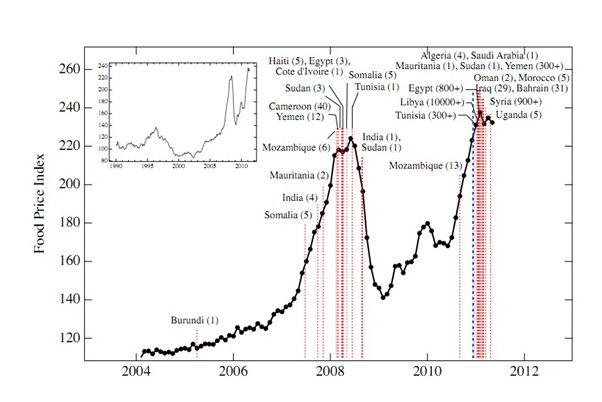
In a 2011 paper, researchers at the Complex Systems Institute unveiled a model that accurately explained why the waves of unrest that swept the world in 2008 and 2011 crashed when they did. The number one determinant was soaring food prices. Their model identified a precise threshold for global food prices that, if breached, would lead to worldwide unrest.
The MIT Technology Review explains how CSI's model works: "The evidence comes from two sources. The first is data gathered by the United Nations that plots the price of food against time, the so-called food price index of the Food and Agriculture Organisation of the UN. The second is the date of riots around the world, whatever their cause." Plot the data, and it looks like this:
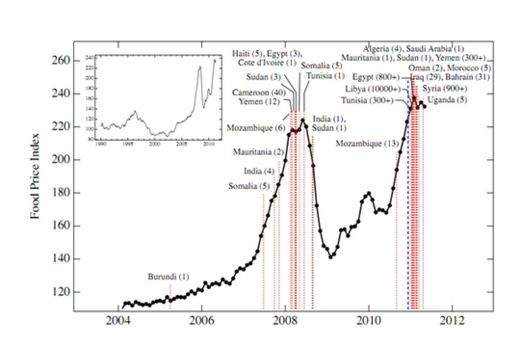
In a 2011 paper, researchers at the Complex Systems Institute unveiled a model that accurately explained why the waves of unrest that swept the world in 2008 and 2011 crashed when they did. The number one determinant was soaring food prices. Their model identified a precise threshold for global food prices that, if breached, would lead to worldwide unrest.
The MIT Technology Review explains how CSI's model works: "The evidence comes from two sources. The first is data gathered by the United Nations that plots the price of food against time, the so-called food price index of the Food and Agriculture Organisation of the UN. The second is the date of riots around the world, whatever their cause." Plot the data, and it looks like this:
Germany Can Ratify ESM Fund With Conditions, Court Rules
Germany’s top constitutional court rejected efforts to block a permanent euro-area rescue fund, handing a victory to Chancellor Angela Merkel, who championed the 500 billion-euro ($645 billion) bailout.
http://www.bloomberg.com/news/2012-09-12/germany-can-ratify-esm-bailout-fund-with-conditions-court-rules.html
http://www.bloomberg.com/news/2012-09-12/germany-can-ratify-esm-bailout-fund-with-conditions-court-rules.html
Saturday, September 8, 2012
EES: Short-Term Euro To Breakout Higher, Then Its Time To Short
Based on the financial crisis in Europe, we wrote an article about a euro shorting opportunity, "Sell the euro on spikes." On Friday, the euro (FXE) reached recent highs above $1.28. This is clearly a spike. However, the euro may be in for a short-term rally, so traders should wait until the momentum subsides before shorting. It seems the spike is not over.
http://seekingalpha.com/article/854961-short-term-euro-to-breakout-higher-then-its-time-to-short
http://seekingalpha.com/article/854961-short-term-euro-to-breakout-higher-then-its-time-to-short
Subscribe to:
Posts (Atom)