Tuesday, March 24, 2020

Amazon’s Bezos, Other Corporate Executives Sold Shares Just in Time

From WSJ:

Top executives at U.S.-traded companies sold a total of roughly $9.2 billion in shares of their own companies between the start of February and the end of last week, a Wall Street Journal analysis shows.
The selling saved the executives—including many in the financial industry—potential losses totaling $1.9 billion, according to the analysis, as the S&P 500 stock index plunged about 30% from its peak on Feb. 19 through the close of trading March 20.
The Journal examined more than 4,000 regulatory filings related to stock sales between Feb. 1 and March 19 by corporate officers of companies traded in the U.S. Avoided losses for the seller are based on the change in the value of each stock between when it was sold and March 20.
By far the largest executive seller was Amazon. AMZN 1.96% com Inc. Chief Executive Jeffrey Bezos, who sold a total of $3.4 billion in Amazon AMZN 1.96% shares in the first week  of February, shortly before the stock market peaked, allowing him to avoid paper losses of roughly $317 million if he had held the stock through March 20, according to the Journal analysis.
The sales represented roughly 3% of Mr. Bezos’s Amazon AMZN 1.96% holdings, according to the most recently available regulatory filings. He sold almost as much stock during the first week in February as he sold during the previous 12 months.
Amazon AMZN 1.96% didn’t immediately provide a comment on behalf of Mr. Bezos.
Bezos's Stock SalesIn 2020, CEO Jeffrey Bezos has already soldmore Amazon stock than in any prior year.Sales of Amazon stock by Jeff BezosSource: SEC filingsNote: 2020 sales through March 19
.billionFebruary and MarchRest of the year2010’12’14’16’18’2001234$5
There is no suggestion that the executives sold shares based on any inside information. The stock market hit an all-time high in February, and executives often sell shares early in the year for tax and other reasons, including preset trading strategies. But the amount of stock sold by executives and officers of U.S.-listed companies was up by roughly one-third from the comparable periods in the previous two years, according to the analysis of regulatory filings and data from S&P Global Market Intelligence.
Jeff Bezos sold a total of $3.4 billion in Amazon shares between Feb. 3 and Feb. 6.Amazon.com share priceSources: FactSet (Amazon); SEC filings (Bezos sales)
Dec. 30Jan. 13Jan. 27Feb. 10Feb. 24March 9March 231,6501,7001,7501,8001,8501,9001,9502,0002,0502,1002,150$2,200Feb 26, 2020x$1,979.59
During the same period in February and March of 2019, corporate officers sold about $6.4 billion worth of stock
While Mr. Bezos’s sales accounted for more than a third of the 2020 sales, thousands of other insiders sold stock. More than 150 executives and officers individually sold at least $1 million worth of stock in February and March after having sold no stock in the previous 12 months, the Journal analysis found.
Wall Street executives also sold large dollar amounts, including Laurence Fink, CEO of BlackRock Inc., who sold $25 million of his company shares on Feb. 14, pre-empting potential losses of more than $9.3 million and Lance Uggla, CEO of IHS Markit Ltd., a data and analytics firm, who sold $47 million of his shares around Feb. 19. Those shares would have dropped in value by $19.2 million if Mr. Uggla had retained them. A spokesperson said the shares were sold under a preset plan.
A spokesperson for BlackRock said Mr. Fink’s sales were a small percentage of his holdings and that he sold $18 million in stock around the same time last year. The sales were about 5% or less of Mr. Fink’s holdings, according to his latest filing.
Some of the nation’s most vulnerable industries are reeling because of the coronavirus pandemic, and the trading by top executives meant less in the way of personal stock losses.
Recent state government orders to limit gatherings have all but shut down some industries, and it is unclear how the public will react even when those lockdowns ease.
Some of the selling was prompted by government-sanctioned trading plans, known as 10b5-1 plans, that allow corporate executives and directors to set in advance the sale of stock for certain prices or dates.
The stock market’s plunge may have triggered some plans, depending on the details, says Adam Epstein, who advises companies on corporate governance practices.
“What doesn’t change—even if there is such a plan—is that optically from an investor’s perspective it is always bad for investors when CEOs sell shares,” Mr. Epstein said. He advises chief executives to construct their investment portfolios so they aren’t forced to sell shares in order to raise cash if their company’s stock falls sharply.
Some of the executives who sold stock came from industries most battered by the economic crisis. James Murren, outgoing CEO of MGM Resorts International, sold $22.2 million of his company’s stock, staving off a possible $15.9 million loss. The company’s shares closed at $9.11 on Friday, down 73% from their February high.
Mr. Murren sold the shares, around the market peak, on Feb. 19 and Feb. 20. A spokesperson noted that the sales came one week after Mr. Murren announced he was leaving MGM. On March 22, Nevada Gov. Steve Sisolak tapped him to lead the state’s response to the coronavirus outbreak.
Among the executives who sold stock this year but not last year was Marc Rowan, co-founder and director of Apollo Global Management Inc. He sold $99 million in February and early March, avoiding paper losses of about $40 million. A spokesperson pointed to an Apollo public filing that described a plan, put in place last fall, allowing Mr. Rowan to sell shares.
Last week, several members of Congress, their spouses and investment advisers drew fire because they sold stock after the lawmakers met to discuss the threat of coronavirus.
Sen. Richard Burr (R., N.C.) sits on two committees that received detailed briefings on the epidemic. On Feb. 13, he and his wife sold as much as $1.7 million in stock. Sen. Kelly Loeffler (R., Ga.) also sold shares.
Ms. Loeffler said she was unaware of the trades and that they were handled by advisers. Mr. Burr said he relied on public news reports in making his trading decisions.
Ms. Loeffler’s husband, Jeffrey Sprecher, chief executive of Intercontinental Exchange Inc., ICE 10.19% owner of the New York Stock Exchange, sold $18 million in shares of the company he heads during the period, including $15 million in March. That compares with a monthly average of less than $2 million stock in 2019, according to the analysis.
If he had held the stock, it would have declined by about $3 million in value, according to the Journal analysis. Intercontinental Exchange said in a statement that Mr. Sprecher’s sales were part of a prescheduled trading plan.
As the stock market fell, Marsh & McLennan Cos. CEO Daniel Glaser sold $26.5 million in stock, shaving $6.7 million in potential losses. Securities and Exchange Commission filings show the sales came under a preset plan and that he sold in March in the two previous years as well.
Bond-rating company Moody’s Corp. CEO Raymond McDaniel sold shares totaling $10 million, compared with his monthly average of $3.3 million in 2019. He spared himself about $2.7 million in paper losses through the trades, the Journal analysis shows.
A spokesperson for Moody’s said Mr. McDaniel’s sales were “carried out through an automated exercise of stock options pursuant to a Rule 10b5-1 trading plan put in place in November of last year.” The plan hasn’t been altered since that time, the spokesperson said.

Fed Digital Dollars Are Part of Debate Over Coronavirus Stimulus

From WSJ:

While it may not make it to the finished coronavirus economic stimulus and support package now being weighed in Congress, there is a push from some legislators to give the Federal Reserve a new tool some believe could radically reshape how it conducts monetary policy.
At issue are so-called digital dollars and the accounts that would hold them. Separate House and Senate bills propose creating these two things as part of a broader effort to reduce the shock of the economic shutdown related to limiting the spread of the coronavirus.
These Fed “digital dollar” accounts would be set up as a way to speed payments to households that need support. As things now stand, the U.S. government lacks the infrastructure to disperse payments widely, and given the nature of the current crisis, speedy action is critical.
The central bank has already taken bold action to support the financial system, including slashing short-term rates to near zero, but almost all of its actions have been aimed at banks and companies. Households have yet to receive any meaningful support.
In the longer run, Fed accounts could also help make monetary policy more powerful and help it bypass a fickle financial system and head right to Main Street. Instead of the Fed taking action to influence market rates, which can be a fraught process, it could offer interest-bearing accounts directly to the public. Then, by changing rates at that level, or even straight up adding Fed-created money to the accounts, it could influence economic decision-making at the household level.
Fed accounts “would be a very significant improvement” in getting money speedily to those who need it most, said Andrew Levin, an economics professor at Dartmouth College who has called for the Fed to launch a digital currency.
Prof. Levin says that in the current situation, it doesn’t matter if these Fed accounts got stimulus funds from the Treasury Department or through money printing directly at the Fed. The main issue is just getting money out the door quickly in a fast-moving crisis, he said.
Even if Fed digital accounts aren’t in place to deal with the current crisis, they can build out the tool kit for dealing with future stress, supporters say.
The debate over an official Fed dollar, distinct but equivalent to the dollar that now exists, has been brewing for several years, partly in reaction to private systems such as bitcoin. To some extent, Fed digital dollars are as much about payment system infrastructure because most dollars are already electronic.Julia Coronado, of MacroPolicy Perspectives LLC, along with Simon Potter, the former manager of the New York Fed’s markets desk, wrote in a forthcoming paper about the benefits of the central bank having digital accounts available to everyday people. “Boosting consumer demand directly is likely to be more effective and have better distributional implications than the current approach of boosting asset prices” through asset buying, and “it can be implemented faster than discretionary fiscal stimulus,” they wrote.
If legislation does create official Fed digital money, the central bank would have something it has yet to seek actively, even as other central banks are trying out their own digital systems. In February, Fed Chairman Jerome Powell said that there are privacy concerns around a digital currency offered by the central bank and that Americans still have a strong preference for cash.

House Stimulus Bill Creates "Digital Dollar" To Send Virus-Aid To The 'Unbanked'

From Zero Hedge:

Update (1115ET)Coindesk's Nikhilish De reports that mentions of a "digital dollar" in a coronavirus-related relief bill before the U.S. House of Representatives have been scrubbed.
House Democrats' latest version of the "Take Responsibility for Workers and Families Act," revealed late Monday, does not contain any language around a "digital dollar" in its section on direct stimulus payments.
*  *  *
As CoinTelegraph's Kollen Post detailed earlier, amid contentious debate over the massive stimulus package in response to the coronavirus pandemic, Democrats in the United States House of Representatives look to implement the digital dollar to streamline payments to U.S. citizens outside of the traditional financial system.

A digital dollar for direct payments to families 

draft of the legislation circulating as of March 23 proposes the creation of digital wallets for U.S. citizens to be maintained by the Federal Reserve within a section entitled “Direct Stimulus Payments for Families.”
Under the draft bills shared last week, dubbed the “Take Responsibility for Workers and Families Act” and the “Financial Protections and Assistance for America’s Consumers, States, Businesses, and Vulnerable Populations Act,” the Federal Reserve could use a “digital dollar” and digital wallets to send payments to “qualified individuals,” consisting of $1,000 for minors and $2,000 to legal adults (to every adult earning less than $75,000 a year, at which points the payments taper off).
These payments would last until the economy recovers. 
While the proposal does indicate the option of providing checks, it would require member banks of the federal reserve to maintain digital dollar wallets for all clients.
Both bills employ identical language around the digital dollar suggestion.
The term ‘digital dollar’ shall mean a balance expressed as a dollar value consisting of digital ledger entries that are recorded as liabilities in the accounts of any Federal Reserve bank; or an electronic unit of value, redeemable by an eligible financial institution (as determined by the Board of Governors of the Federal Reserve System),” the bills read.

The massive stimulus package and current gridlock

This version of the bill seems to come from the office of Speaker of the House Nancy Pelosi (D-CA). Bloomberg Law puts the bill’s origin date as March 22. 
The bill is massive, with all extant versions clocking in at well over a thousand pages and aiming to distribute upwards of $1.8 trillion. 
On both March 22 and 23, Democrats in the Senate blocked the Republican version of the bill (which did not mention digital dollars). The Democrats criticized the bill for favoring bailouts to big businesses at the expense of everyday citizens. 
As of close of business on March 23, Speaker Pelosi was expected to present a counteroffer in the form of a bill laying out $2.5 trillion in stimulus funding. 
Cointelegraph reached out to the offices of Speaker Pelosi and other representatives but had received no response as of press time. This article will be updated should responses come in.

Monday, March 23, 2020

"Travel Papers" & The Pandemic Patriot Act 2.0

Did you ever think we’d reach the point in the United States where you had to have papers to freely travel from one place to another? It appears we’re at the point.

The MTA issued “travel papers” to their workers

On March 17th, a few days before New York issued a shelter in place order, the Metropolitan Transportation Authority issued “travel papers” to their employees to prepare for a potential coronavirus curfew. The NY Daily News reports:
If non-emergency travel is restricted, workers can show law enforcement officials the letter if they’re stopped on the way to work.
“This letter along with current New York CIty Transit identification identifies this individual as an essential employee who is required to travel during the curfew imposed due to the Coronavirus emergency,” states the letter, which is signed by the Metropolitan Transportation Authority’s Police Department’s acting chief Joseph McGrann. “Please give this individual due consideration during this crisis.”
MTA spokeswoman Abbey Collins said the letter was distributed on Monday to a “limited number of NYCT bus employees living in New Jersey” because the state’s Gov. Murphy suggested imposing a statewide curfew between 8 p.m. and 5 a.m. (source)
Clearly, the wheels have been in motion for several days. And it’s not just the MTA.

Your papers, please.

For everyone who thought the article about the Lockdown of America was a “hysterical overstatement” and that they could still do whatever they wanted because it wasn’t really being enforced, what are you thinking now that “travel papers” are being handed out? To me, this sounds like the lockdowns I wrote of yesterday were just the first incremental step toward a society that nobody hopes to see.
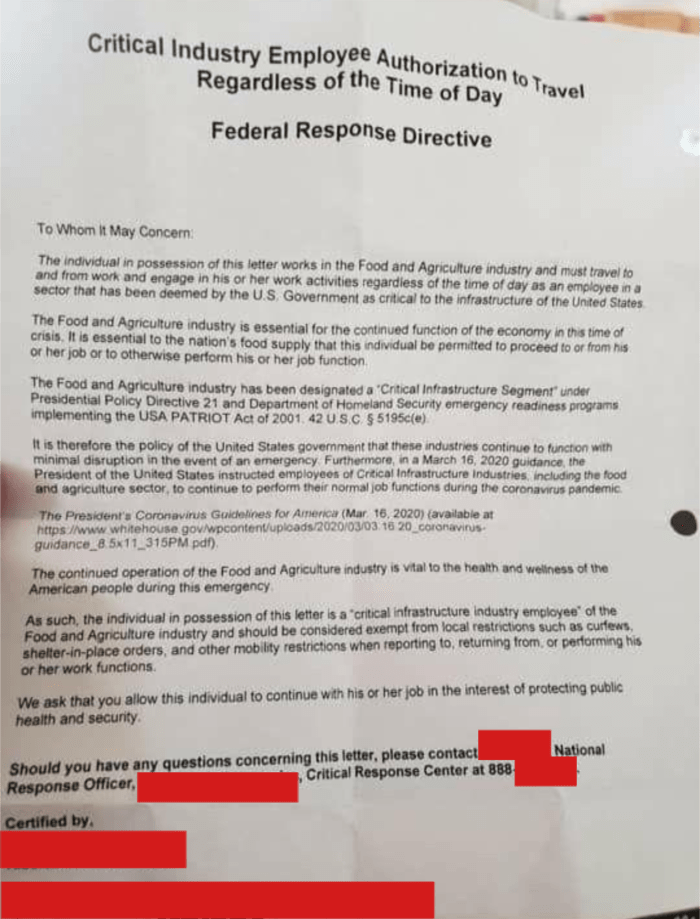
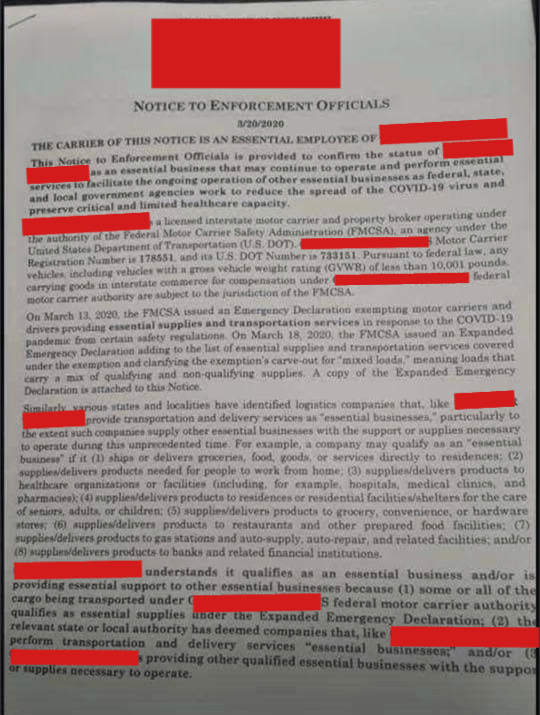
Yesterday, readers sent me photos of “travel papers” provided to them by employers so they could get to and from work. These are employees who work in industries like healthcare, pharmacies, and foodservice, as well as those who work in the production, transport, and sales of essential supplies.
One reader wrote, “We were told to show these if we got stopped on the way to or from work and that if the authorities gave us any trouble, to not argue and just go back home.”
Here are some of the papers that people sent. Identifying information has been redacted.
Papers that people sent were from Pennsylvania, New York, Arizona, Michigan, North Carolina, Kansas, New Jersey, West Virginia, Virginia, Oregon, Florida, Louisiana, and Ohio. Industries mentioned in the papers were trucking, grocery stores, medical clinics, hospitals, nursing homes, city transit workers, railroads, food production plants, pharmacies, gas stations, stores like Target and Walmart, and automotive repair facilities.
Most people were given their papers on Friday or Saturday and told they’d need them to get to and from work starting the week ahead.
I wonder who’s going to be checking your “travel papers.”  Will it be the local PD? The National Guard? The military? Maybe it’ll be all those TSA agents who are currently out of work but already accustomed to molesting innocent travelers.

What does this mean for those told they’d be able to go to the store?

We’ve been repeatedly told during task force press conferences that nobody needs to worry about buying extra supplies because the stores will remain open. We were chastised about stocking up and “hoarding” supplies. But if you need travel papers just to get to work, how will a person get to the store when they need to pick up some groceries? Will these papers only be required during certain hours?
It’s easy to prove you just went to the store when you have a bag of groceries in hand, but how do you prove you are going to the store? Will they just begin distributing the food to us as opposed to allowing people to shop for their own food?
A little clarity and less subterfuge would go a lot further toward preventing concern that we’re about to go full Wuhan here in America.
If I didn’t have supplies already, I would head to the store today and get enough for a couple of extra weeks at the very least. Here are some ideas for finding supplies amidst the picked-over inventory that remains.
So, what happens if you get caught without your papers? I’m glad you asked.

It seems like the DoJ is itching to suspend the Constitution.

At this point, the “Department of Justice” sounds like one of those other phrases the government uses to mean the complete opposite. Like the “Patriot Act” which is as far from patriotic as it gets.
And speaking of the Patriot Act, the government is now introducing what I’d like to dub the Pandemic Patriot Act 2.0.
The DoJ has secretly asked Congress to draft legislation allowing them to indefinitely detain people without due process during the coronavirus pandemic. Because who doesn’t want to add a little spice to our economic crisis with the added threat of indefinite detention?
Documents reviewed by POLITICO detail the department’s requests to lawmakers on a host of topics, including the statute of limitations, asylum and the way court hearings are conducted. POLITICO also reviewed and previously reported on documents seeking the authority to extend deadlines on merger reviews and prosecutions…
…In one of the documents, the department proposed that Congress grant the attorney general power to ask the chief judge of any district court to pause court proceedings “whenever the district court is fully or partially closed by virtue of any natural disaster, civil disobedience, or other emergency situation.”
The proposal would also grant those top judges broad authority to pause court proceedings during emergencies. It would apply to “any statutes or rules of procedure otherwise affecting pre-arrest, post-arrest, pre-trial, trial, and post-trial procedures in criminal and juvenile proceedings and all civil process and proceedings,” according to draft legislative language the department shared with Congress. In making the case for the change, the DOJ document wrote that individual judges can currently pause proceedings during emergencies, but that their proposal would make sure all judges in any particular district could handle emergencies “in a consistent manner.” (source)
What the heck are “pre-arrest” procedures, anyway? Is that the part where government investigators go and set someone up to commit a crime like all those “bombing plots” the FBI keeps saving us from?
I wouldn’t be surprised to see another 300-page legislation like the original Patriot Act that was rolled out just weeks after 911, giving us the TSA, indefinite detention, and all sorts of other dystopian nonsense.

Never let a serious crisis go to waste.

In the infamous words of Rahm Emmanuel, the former mayor of Chicago, “You never let a serious crisis go to waste. And what I mean by that it’s an opportunity to do things you think you could not do before.”
It looks like the government is taking those words to heart with travel papers and new draconian laws.
Since I wrote the article about America locking down yesterday, more states have joined in. Now New York, California, Illinois, Connecticut, and New Jersey are all under restriction.
Is your state coming soon? Are these lockdowns being rolled out incrementally, starting out gently (sure you can walk your dog!) and then moving on to the point where you can’t leave your house without “travel papers?”
So far, 2020 has brought us an out-of-control deadly pandemic, an economic collapsestatewide lockdowns, and now travel papers and a potential new law to eradicate the Fifth Amendment.
I hesitate to ask what’s next.